

Australia — Passport
Australia · Passport
Specifications
| Country | Australia |
|---|---|
| Document type | Passport |
| Passport / visa picture size | Width: 35 mm, Height: 45 mm |
| Aspect ratio | 7:9 (35 × 45 mm) |
| Resolution (DPI) | 600 |
| Required file size (digital) | — |
| Head in photo | Head must be between 70 to 80 % of the photograph from the bottom of the chin to the top of the head |
| Background color | White — plain and evenly lit unless your issuer specifies a different tone. |
| Printable photo | Yes |
| Digital photo for online submission | Yes |
| Digital photo size (pixels) | Width: 826 px, Height: 1062 px |
| Photo paper type | matte |
Official Source
Australian Passport Office — passport photo requirementsFAQ
Bullets are grouped from this country’s requirement text and spec fields. If a topic has no matching lines in our data, we show common international-style guidance—always confirm with your issuer.
1.Photo basics & quality
- Final print size for this preset: 7:9 (35 × 45 mm).
- If you are submitting a full passport application, one of your two photos must be endorsed by a guarantor. An endorsement is not necessary if you are renewing your passport.
- The Australian Passport Office does not endorse particular photo outlets or providers. We recommend that you choose an experienced passport photographer. You should confirm that the photos they take meet our standards.
- Photos printed by inkjet printers are not acceptable as they can introduce lines in the picture when the image is scanned in the application process.
- Please do not attach the photos to your application form as this can damage them if not attached correctly.
- Good quality, colour gloss prints, less than six months old
- Clear, focused image with no marks or 'red eye'
- be signed by a registered medical practitioner
- include the medical practitioner's full name, registration number and the address and phone number of the medical practice.
- Always confirm the latest rules with the official issuing authority or online application portal before you submit.
- Dimensions for this preset: 35 × 45 mm (7:9 (35 × 45 mm)).
- Suggested print resolution: 600 DPI (confirm with your issuer).
- Typical digital dimensions when specified: 826 × 1062 px (confirm upload requirements).
- A printable physical photo may be required for this document type (when applicable).
- Online submission with a digital file may be required (check the current application flow).
- Photo paper when printing: matte.
2.Pose & expression
- Your photo is critical to the usability and security of your passport. The facial recognition technology used in conjunction with Australian passports makes border processing more efficient and reduces the potential for identity fraud. If your photo does not meet the standards detailed below, your passport may not work at automated borders.
- The required dimensions of the photo are 35mm to 40mm wide and 45mm to 50mm high. The size of the face from chin to crown can be up to a maximum of 36mm with a minimum of 32mm.
- For further information, see Camera operator guidelines (pdf) (264 KB) which draw on ICAO standards.
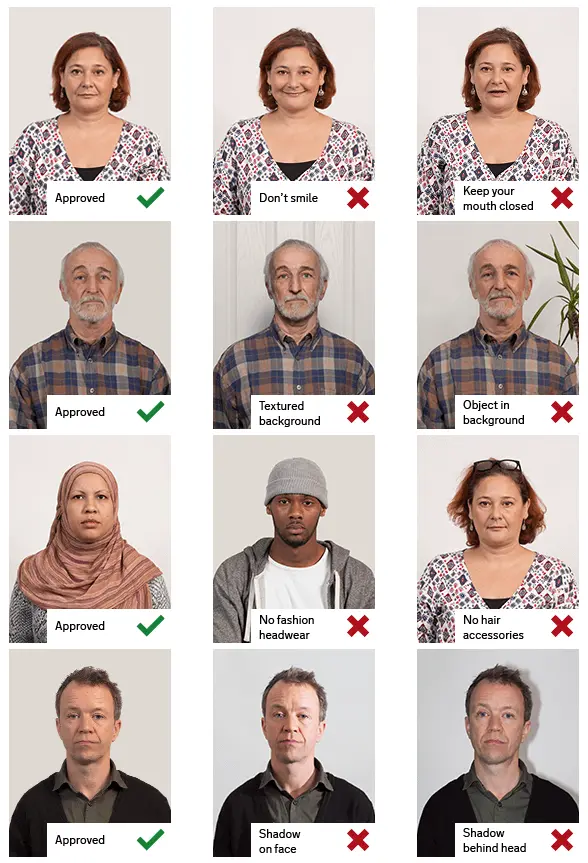
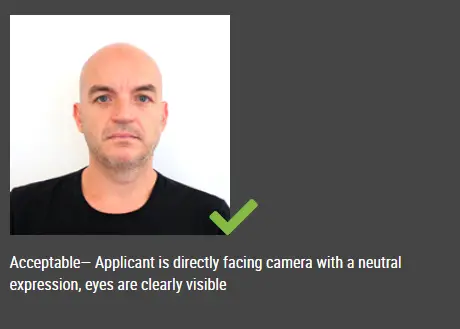
- Face looking directly at the camera and not tilted in any direction
- Eyes open, mouth closed
- Neutral expression (not smiling, laughing or frowning), which is the easiest way for border systems to match you to your image.
- Head size in frame: Head must be between 70 to 80 % of the photograph from the bottom of the chin to the top of the head
3.Attire & accessories
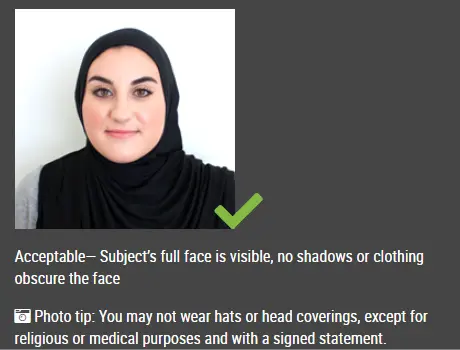
- If you usually cover your head for religious reasons, or you wear facial jewellery, your photo can include these items.
- Head coverings should be plain coloured and must be worn in such a way as to show the face from the bottom of the chin to the top of the forehead, and with the edges of the face visible.
- Jewellery must not obscure any part of the face, especially the area around the eyes, mouth and nose. There must be no reflection from rings or studs.
- Glasses are not allowed in passport photos taken from 1 July 2018. In rare cases they may be permitted where glasses cannot be removed for medical reasons (eg severe light sensitivity or recent eye surgery). Vision impairment alone is not sufficient for medical exemption.
- If glasses must be worn for medical reasons, the frames must not obscure the eyes and there must be no reflection from the lenses. A medical certificate is required. The medical certificate must:
- Hair off the face so that the edges of the face are visible
- state the reason why glasses cannot be removed
4.Lighting & background
- If you are unable to meet the photo requirements due to a medical condition, please explain using a medical certificate or form B11 (pdf) (78.13 KB) where appropriate.
- Plain white or light grey background that contrasts with your face
- Uniform lighting (no shadows or reflections) with appropriate brightness and contrast to show natural skin tone
- Background (summary): White — plain and evenly lit unless your issuer specifies a different tone.
5.Children & infants
- For babies and children under three, a photo with an open mouth is acceptable. The photo must comply with all the other requirements above. No other person or object should be visible in the photo.
Visual guide
Illustrative reference photos served from a third-party CDN. Use only as informal guidance; follow your official instructions.

How an online passport photo generator typically works
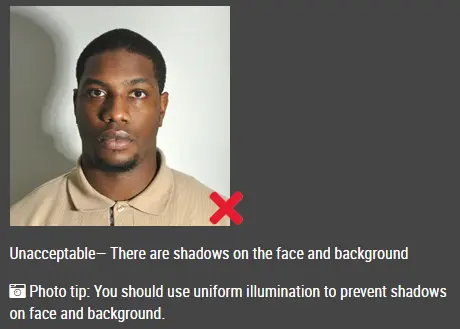
Avoid heavy shadows on the face and background
Even lighting and a clear, frontal face
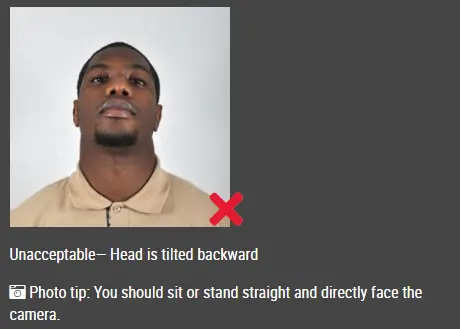
Head should not be tilted or turned away from the camera
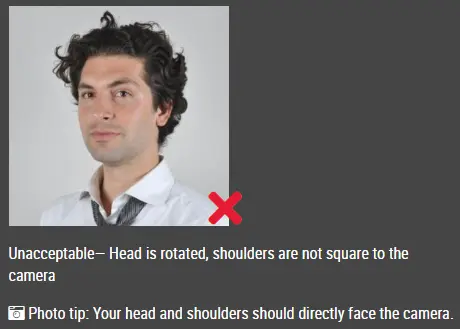
Keep the head straight; do not rotate the face
Face the camera straight on with shoulders visible
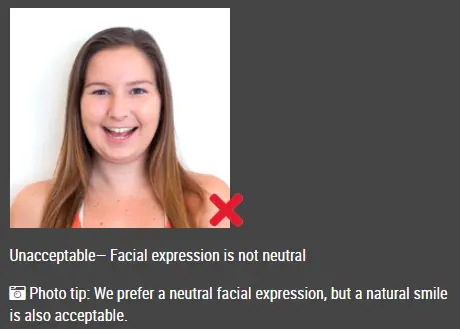
Avoid exaggerated smiles or an open mouth when a neutral look is required
Good and bad sizing / framing examples
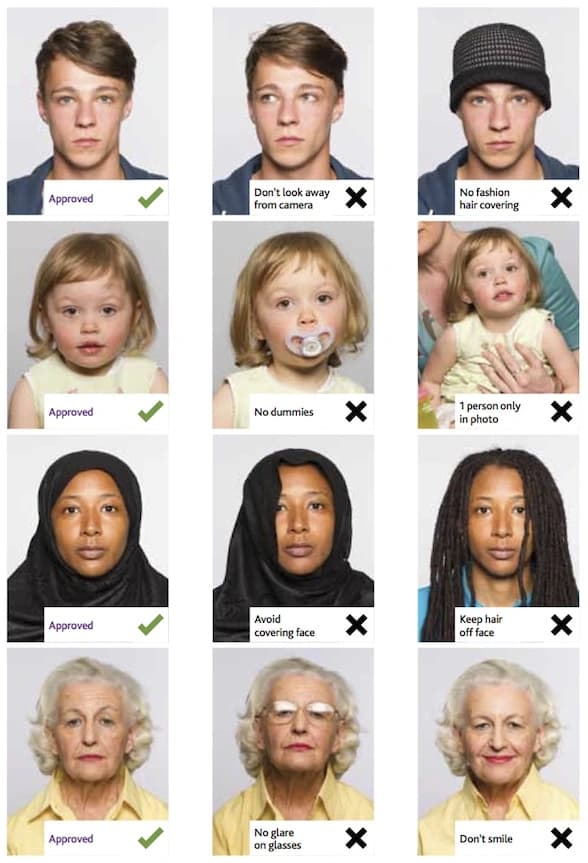
Printed photo strips (layout reference)
How to make this photo
1.Step 1: Use a digital camera or a smartphone
- —Find someone to take the photo for you and selfie photo is not acceptable for passport photo application. If you have a tripod, use it. A tripod will make it easier to keep the camera steady and level. The distance of the person to the camera should be around 1 meter.
2.Step 2: Find a venue with good lighting
- —When taking photo, you should face the light, such as a nice bright window or the door. This can provide even lighting to avoid shadows on the face and background. The face must be evenly lit. There should be no shadows and glares on the face.
- —Note: A simple wall is fine; you can tidy or replace the background while editing.
3.Step 3: Wear properly for your passport photo
- —Do not wear uniforms. Wear regular street clothes in your photo.
- —Do not wear eyeglasses. If you wear glasses, sunglasses, or tinted glasses, take them off for your passport photo.
- —Your face must still be fully visible. Don’t let your hair drape over your face and obscure your eyes. If you have very long bangs that cover your eyebrows, you should pin them back with bobby pins. It’s best if your ears show, as well, but that won’t cause your photo to be rejected.
- —No hats are allowed in passport photos unless it is religious headgear such as a headscarf or yarmulke that you wear every day.
4.Step 4: Pose for a passport
- —Look straight towards the camera with face straight on. Head should not be tilted or rotated.
- —Both ears showing or both edges of the face visible if hair covers the ears.
- —Shoulders should be visible, and there should be enough space around the head for cropping the photo.
- —Position the camera in the same height as the head.
5.Step 5: Have a neutral facial expression
- —You can smile in your passport photos, but the government prefers that you have a neutral facial expression.
- —Smiling or having your mouth open is usually not acceptable, especially under the new international passport rules.
- —Online Passport Photo Generator
Reference summary aligned with common third-party requirement listings. Always verify against the official embassy or visa center before you submit.